
American foulbrood (AFB) in honey bees
American foulbrood is a serious and reportable bacterial disease that infects honey bee larvae, killing them in the cell and weakening the colony as a result. It spreads easily and persists in equipment for many decades due to highly resistant spores.
Although the pathogen is widespread, clinical disease is less common. When it appears, it requires immediate action.
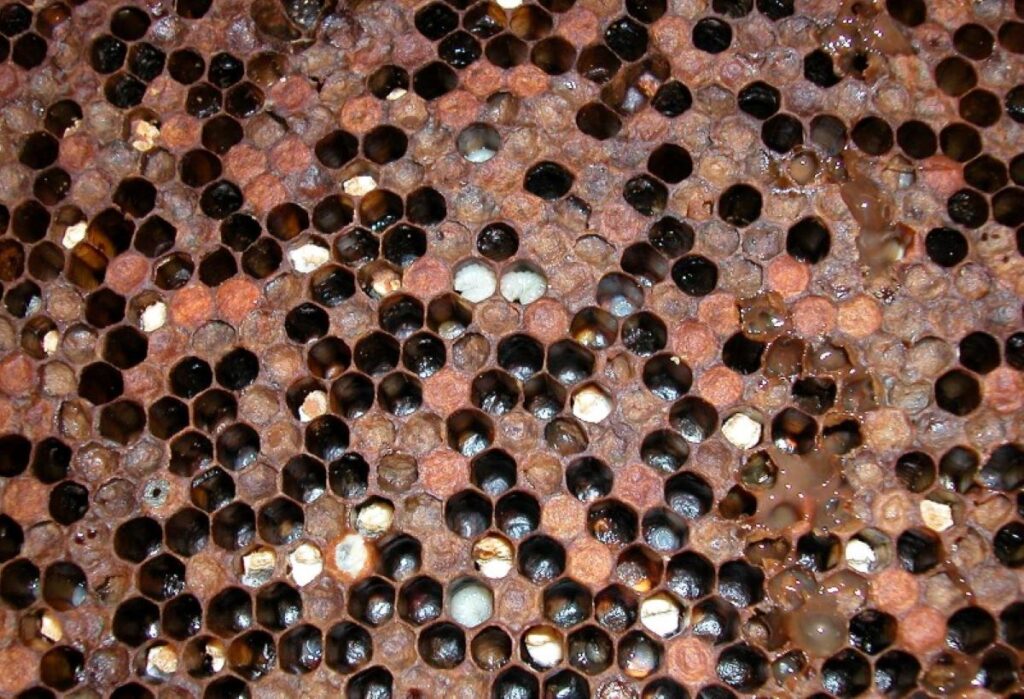
Typical signs include sunken or perforated cappings, a scattered brood pattern, ropy larval remains, and dark scale adhered to the bottom of cells.
Visual signs of AFB
Sunken, greasy, or perforated cappings
Capped brood appears collapsed, dark, greasy, or punctured. Brood pattern is irregular and spotty.
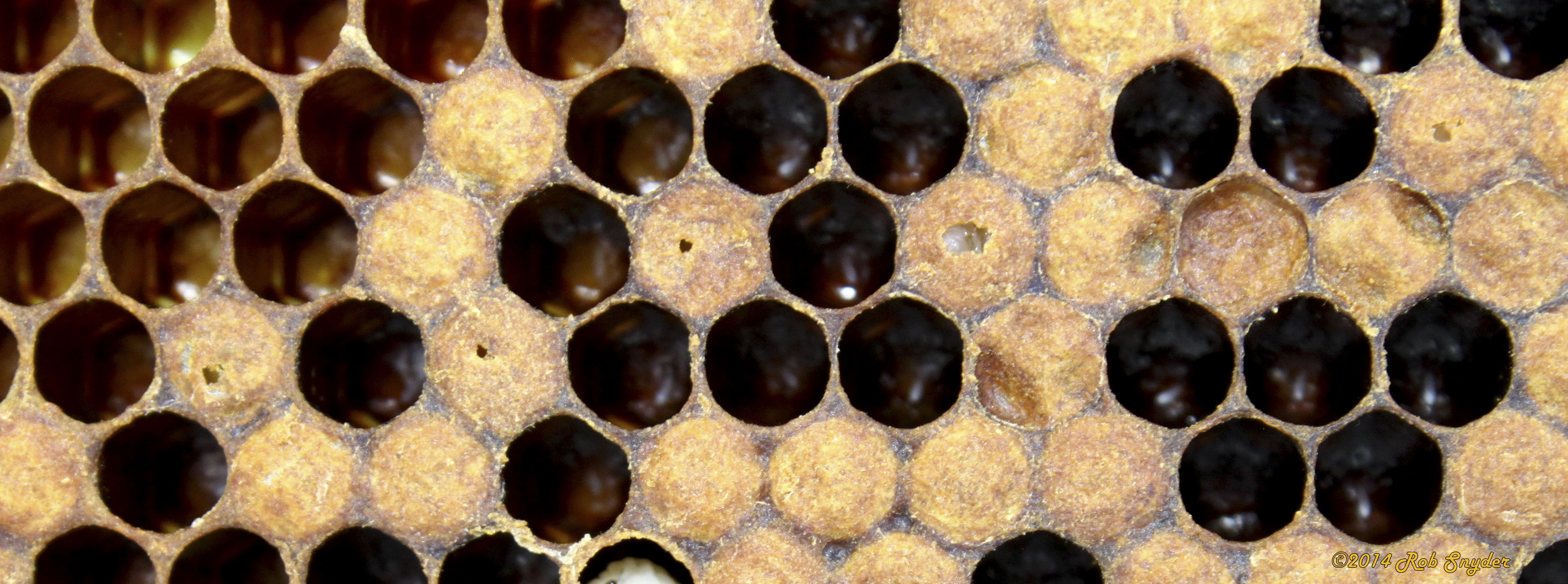
Ropy larval remains
Dead larvae can be drawn out into rope-like strands. Lasts for about three weeks after larval death.
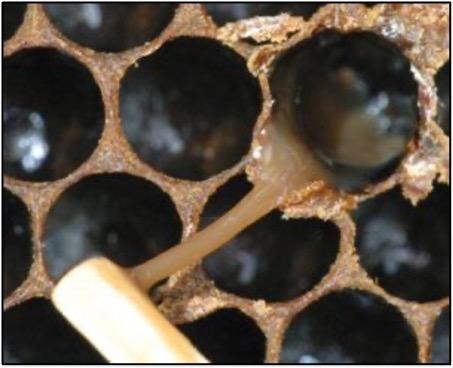
Dark scale in cells
Dried remains adhere tightly to the bottom of brood cells. AFB scales glow under a black light.
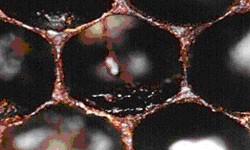
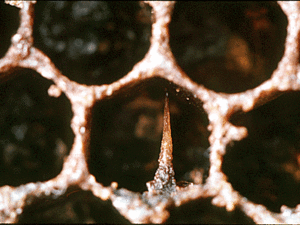
Pupal tongue
In some cases, the developing pupa’s tongue protrudes upward from the cell.
American foulbrood (AFB) in honey bees
American foulbrood is a serious and reportable bacterial disease that infects honey bee larvae, killing them in the cell and weakening the colony as a result. It spreads easily and persists in equipment for many decades due to highly resistant spores.
Although the pathogen is widespread, clinical disease is less common. When it appears, it requires immediate action.
Typical signs include sunken or perforated cappings, a scattered brood pattern, ropy larval remains, and dark scale adhered to the bottom of cells.
Visual signs of AFB
Sunken, greasy, or perforated cappings
Capped brood appears collapsed, dark, greasy, or punctured. Brood pattern is irregular and spotty.
Ropy larval remains
Dead larvae can be drawn out into rope-like strands. Lasts for about three weeks after larval death.
Dark scale in cells
Dried remains adhere tightly to the bottom of cells. Scales glow under a black light.
Pupal tongue
In some cases, the developing pupa’s tongue protrudes upward from the cell.
American foulbrood (AFB) in honey bees
American foulbrood is a serious and reportable bacterial disease that infects honey bee larvae, killing them in the cell and weakening the colony as a result. It spreads easily and persists in equipment for many decades due to highly resistant spores.
Although the pathogen is widespread, clinical disease is less common. When it appears, it requires immediate action.
Typical signs include sunken or perforated cappings, a scattered brood pattern, ropy larval remains, and dark scale adhered to the bottom of cells.
Visual signs of AFB
Sunken, greasy, or perforated cappings
Capped brood appears collapsed, dark, greasy, or punctured. Brood pattern is irregular and spotty.
Ropy larval remains
Dead larvae can be drawn out into rope-like strands. Lasts for about three weeks after larval death.
Dark scale in cells
Dried remains adhere tightly to the bottom of brood cells. AFB scales glow under a black light.
Pupal tongue
In some cases, the developing pupa’s tongue protrudes upward from the cell.
How a diagnosis is made
Diagnosis is based on characteristic brood changes, supported by field testing and confirmed when needed.
Visual exam and other findings
AFB has a recognizable presentation, including sunken caps, ropy larvae, and persistent scale. A strong, unpleasant odor may be present, especially in advanced cases. Odor alone is not enough to diagnose AFB.
Field Assessment
The rope test is commonly used to support diagnosis. Field test kits may also be used to detect the pathogen directly in the hive.
Laboratory confirmation
Because AFB is a reportable disease, laboratory confirmation may be recommended or required depending on the situation.
How a diagnosis is made
Diagnosis is based on characteristic brood changes, supported by field testing and confirmed when needed.
Visual exam and other findings
AFB has a recognizable presentation, including sunken caps, ropy larvae, and persistent scale. A strong, unpleasant odor may be present, especially in advanced cases. Odor alone is not enough to diagnose AFB.
Field Assessment
The rope test is commonly used to support diagnosis. Field test kits may also be used to detect the pathogen directly in the hive.
Laboratory confirmation
Because AFB is a reportable disease, laboratory confirmation may be recommended or required depending on the situation.
How a diagnosis
is made
Diagnosis is based on characteristic brood changes, supported by field testing and confirmed when needed.
Visual exam and other findings
AFB has a recognizable presentation, including sunken caps, ropy larvae, and persistent scale. A strong, unpleasant odor may be present, especially in advanced cases. Odor alone is not enough to diagnose AFB.
Field Assessment
The rope test is commonly used to support diagnosis. Field test kits may also be used to detect the pathogen directly in the hive.
Laboratory confirmation
Because AFB is a reportable disease, laboratory confirmation may be recommended or required depending on the situation.
Treatment and management
AFB is managed by removing sources of infection and protecting the rest of the yard.
Removal of the source
Colonies with AFB are typically euthanized and destroyed to eliminate the source of spores. This includes burning the hives and infected equipment, following state-guided destruction protocols.
Antibiotics for exposed colonies
Antibiotics do not cure AFB and do not kill spores. They suppress the active bacteria only, and resistant strains have been documented. In some cases, antibiotics can be used in surrounding, exposed colonies to reduce the risk of additional clinical outbreaks while contaminated equipment is removed or destroyed.
Limit spread in the yard
Avoid moving frames or equipment between colonies
Avoid combining or splitting hives during an active issue
Minimize robbing pressure
Reduce risk
AFB risk is reduced by avoiding shared equipment between operations, replacing old comb every few years, buying new equipment when possible, and cleaning hive tools between yards. For detailed prevention guidance, your local bee club, apiary inspector, and university extension are good resources.
Treatment and management
AFB is managed by removing sources of infection and protecting the rest of the yard.
Removal of the source
Colonies with AFB are typically euthanized and destroyed to eliminate the source of spores. This includes burning the hives and infected equipment, following state-guided destruction protocols.
Antibiotics for exposed colonies
Antibiotics do not cure AFB and do not kill spores. They suppress the active bacteria only, and resistant strains have been documented. In some cases, antibiotics can be used in surrounding, exposed colonies to reduce the risk of additional clinical outbreaks while contaminated equipment is removed or destroyed.
Limit spread in the yard
Avoid moving frames or equipment between colonies
Avoid combining or splitting hives during an active issue
Minimize robbing pressure
Reduce risk
AFB risk is reduced by avoiding shared equipment between operations, replacing old comb every few years, buying new equipment when possible, and cleaning hive tools between yards. For detailed prevention guidance, your local bee club, apiary inspector, and university extension are good resources.
Treatment and management
AFB is managed by removing sources of infection and protecting the rest of the yard.
Removal of the source
Colonies with AFB are typically euthanized and destroyed to eliminate the source of spores. This includes burning the hives and infected equipment, following state-guided destruction protocols.
Antibiotics for exposed colonies
Antibiotics do not cure AFB and do not kill spores. They suppress the active bacteria only, and resistant strains have been documented. In some cases, antibiotics can be used in surrounding, exposed colonies to reduce the risk of additional clinical outbreaks while contaminated equipment is removed or destroyed.
Limit spread in the yard
Avoid moving frames or equipment between colonies
Avoid combining or splitting hives during an active issue
Minimize robbing pressure
Reduce risk
AFB risk is reduced by avoiding shared equipment between operations, replacing old comb every few years, buying new equipment when possible, and cleaning hive tools between yards. For detailed prevention guidance, your local bee club, apiary inspector, and university extension are good resources.